 |
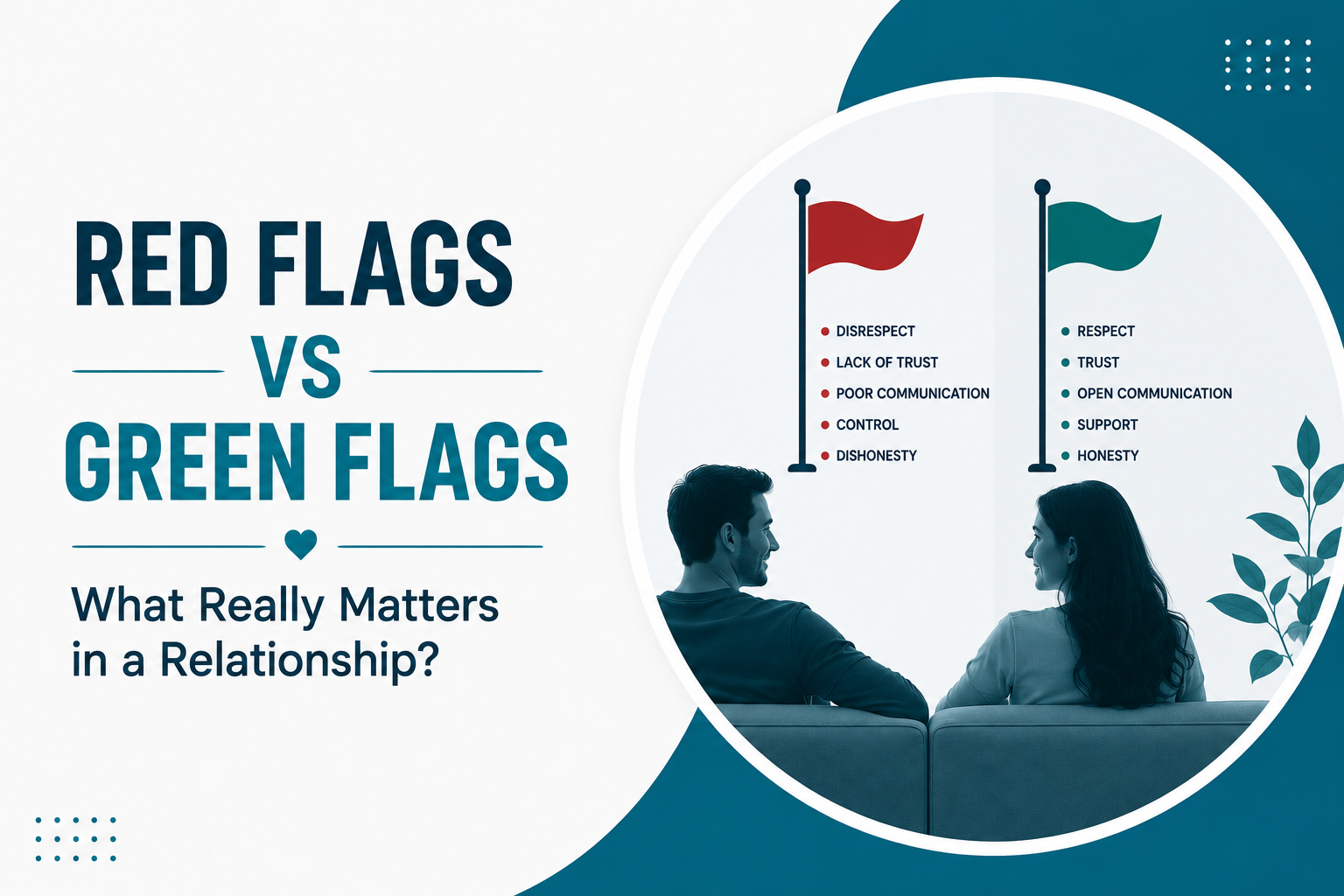
Red Flags vs Green Flags: What Really Matters in a Relationship?Love can make people overlook red flags. Fear can make them question green flags. Emotional intelligence helps us see the difference. In today's dating and relationship world, terms like red flags, green flags, toxic relationship, healthy relationship, attachment style, and emotional availability are everywhere. A delayed reply becomes a red flag. Wanting personal space becomes a red flag. Being highly attentive becomes a green flag. Buying expensive gifts becomes proof of love. |
But is a healthy relationship really that simple?
No.
As a relationship coach, one of the biggest mistakes I see people make is judging relationships based on isolated behaviours rather than consistent emotional patterns.
A single disagreement does not automatically mean your relationship is toxic.
One romantic gesture does not automatically mean someone is emotionally healthy.
The real question is:
"How does this relationship consistently affect your emotional safety, self-respect, trust and ability to be yourself?"
For married couples, dating individuals and people navigating modern relationships in cities such as Mumbai, Delhi NCR, Bengaluru, Hyderabad, Chennai, Pune and Kolkata, understanding the difference between genuine red flags and meaningful green flags has become more important than ever.
Because a successful career, financial stability, social status and lifestyle compatibility cannot compensate for a relationship that lacks trust, emotional maturity and psychological safety.
Let's understand what really matters.
What Are Red Flags in a Relationship?
A red flag in a relationship is not simply a behaviour you dislike.
It is a repeated pattern that may indicate :
- Emotional manipulation
- Lack of respect
- Dishonesty
- Controlling behaviour
- Poor emotional regulation
- Inability to take responsibility
- Violation of boundaries
- Emotional or psychological harm
The important word is pattern.
Everyone has bad days.
Everyone can communicate poorly sometimes.
Everyone can make mistakes.
But emotionally healthy people are generally willing to :
1. Recognise the impact of their behaviour.
2. Take responsibility.
3. Repair the damage.
4. Make an effort to change repeated unhealthy patterns.
A major red flag is often not the mistake itself.
It is what happens after you communicate that the behaviour has hurt you.
What Are Green Flags in a Relationship?
A green flag is a consistent sign of emotional health, relational maturity and the potential for a secure relationship.
Green flags often include :
- Emotional safety
- Respect for boundaries
- Honest communication
- Consistency
- Accountability
- Mutual effort
- Healthy conflict resolution
- Trust
- Empathy
- Respect for individuality
The healthiest relationships are not relationships without conflict.
They are relationships where two people know how to handle conflict without destroying emotional connection.
That is a major difference.
Red Flags vs Green Flags: The Biggest Differences
| Red Flag | Green Flag |
|---|---|
| Avoids responsibility | Takes accountability |
| Uses silence to punish | Takes space and communicates why |
| Becomes defensive during feedback | Listens and reflects |
| Makes you feel guilty for having boundaries | Respects your boundaries |
| Love feels unpredictable | Affection and effort are reasonably consistent |
| Controls your choices | Supports your individuality |
| Hides important information | Practices honesty and transparency |
| Turns every conflict into a personal attack | Focuses on solving the problem |
| Blames everyone else | Can admit mistakes |
| Makes you constantly question your worth | Helps create emotional safety |
The difference is not perfection.
The difference is emotional maturity.
10 Important Red Flags in a Relationship You Should Not Ignore
1. They Constantly Disrespect Your Boundaries
A healthy partner may not always agree with your boundaries.
But they should respect them.
For example :
You say you are uncomfortable with something, but they repeatedly pressure you.
You ask for privacy, but they invade it.
You say no, but they keep negotiating until you give in.
This can be a serious relationship warning sign.
Love without respect is not healthy love.
2. They Never Take Responsibility
Pay attention to what happens after conflict.
Do they say :
> "You made me do this."
> "You are too sensitive."
> "This is all because of you."
> "Everyone else is the problem."
A person who cannot take responsibility will make emotional growth inside the relationship extremely difficult.
A powerful green flag is hearing :
"I understand why that hurt you. I could have handled that better."
Accountability builds trust.
Defensiveness slowly destroys it.
3. You Constantly Feel Emotionally Confused
Do you often find yourself thinking :
> "Do they really love me?"
> "Why are they suddenly distant?"
> "Was I wrong for feeling hurt?"
> "Why do I always end up apologising?"
> "Why do I feel anxious all the time?"
Occasional uncertainty is normal.
But constant emotional confusion deserves attention.
Healthy love does not guarantee certainty every day, but over time, it should provide more clarity than chaos.
4. They Use Love as a Tool for Control
Love can become unhealthy when affection is used to manipulate behaviour.
Examples include :
> Withdrawing affection to punish you
> Threatening to leave during every argument
> Using jealousy to control you
> Demanding access to your phone, passwords or private conversations
> Isolating you from friends or family
This is not emotional closeness.
It is control disguised as concern.
5. They Are Consistently Dishonest
Trust is not built through promises.
It is built through repeated honesty.
A relationship cannot become emotionally secure when one partner constantly hides, lies or changes their story.
The issue is not only the lie.
It is the emotional environment created by dishonesty.
You begin questioning :
> What is true?
> What else do I not know?
> Can I trust my own judgement?
Trust requires consistency between words, actions and reality.
6. Every Conflict Becomes an Attack
Conflict is normal.
Personal attacks are not healthy communication.
Watch for patterns such as :
> Name-calling
> Humiliation
> Bringing up past mistakes to win
> Threatening the relationship
> Insulting your personality
> Attacking your insecurities
A mature partner can disagree without trying to emotionally destroy you.
The goal of conflict should be understanding, not winning.
7. They Make You Feel Responsible for Their Emotions
You are responsible for your behaviour.
You are not responsible for managing another adult's entire emotional world.
Statements like :
"If you loved me, you would do exactly what I want."
or
"You are the reason I am unhappy."
can create unhealthy emotional pressure.
Empathy is important.
But emotional responsibility must remain individual.
8. The Relationship Is Extremely Intense but Emotionally Unstable
Sometimes people confuse intensity with compatibility.
The relationship moves very quickly.
There are extreme highs.
Then dramatic lows.
Then apologies.
Then intense romance again.
This emotional rollercoaster can feel passionate, but emotional instability is not the same as deep love.
Healthy relationships often feel less dramatic and more secure.
And for someone used to chaos, emotional stability can initially feel unfamiliar or even "boring."
9. You Are Slowly Losing Yourself
Ask yourself :
Who was I before this relationship?
Have you stopped :
> Seeing people you love?
> Pursuing your interests?
> Expressing your opinions?
> Making independent decisions?
> Feeling confident?
A healthy relationship should expand your life.
It should not gradually shrink your identity.
10. They Refuse to Repair Repeated Hurt
This is one of the most important red flags.
Every relationship involves mistakes.
But when you repeatedly communicate the same issue and nothing changes, pay attention.
An apology without behavioural change eventually loses meaning.
"I'm sorry" is important.
But healthy repair also includes :
"What can I do differently next time?"
10 Powerful Green Flags in a Healthy Relationship
Now let's look at the signs that often matter even more than grand romantic gestures.
1. You Feel Emotionally Safe
Emotional safety means you can express :
> Disappointment
> Fear
> Anger
> Needs
> Boundaries
> Vulnerability
without constantly fearing humiliation, punishment or abandonment.
You may not always agree.
But you can speak honestly.
That is powerful.
2. They Are Consistent
Consistency is one of the most underrated forms of love.
A partner does not need to be perfect every day.
But their basic level of care, respect and effort should not feel completely unpredictable.
Consistency creates trust.
Trust creates emotional security.
And emotional security allows intimacy to deepen.
3. They Can Handle Difficult Conversations
A major green flag is not someone who avoids conflict.
It is someone who can say :
"Let's talk about this."
Even when the conversation is uncomfortable.
Emotionally mature couples understand that avoiding every difficult conversation does not create peace.
It often creates distance.
4. They Respect Your Individuality
Healthy love does not require two people to become one identity.
You can love your partner and still have :
> Friends
> Career goals
> Personal interests
> Family relationships
> Time alone
> Independent opinions
A strong relationship contains both :
Connection and individuality.
5. They Take Accountability
One of the strongest green flags is the ability to admit:
"I was wrong."
This does not make a person weak.
It makes emotional intimacy safer.
When both partners can take responsibility, problems become easier to solve.
Because the relationship stops becoming:
Me vs You
and starts becoming:
Us vs The Problem
6. Your Boundaries Are Respected
A healthy partner does not need to love every boundary you create.
But they should respect your right to have one.
Whether it involves :
> Personal time
> Physical boundaries
> Family boundaries
> Financial decisions
> Privacy
> Communication expectations
Mutual respect is more sustainable than forced agreement.
7. They Celebrate Your Growth
A secure partner does not feel threatened every time you grow.
Your success does not have to become their insecurity.
A powerful green flag is someone who asks :
"What do you need to become the best version of yourself?"
Healthy love is not possession.
It is partnership.
8. You Can Repair After Conflict
Every couple will have disagreements.
The important question is :
Can you reconnect afterwards?
Healthy repair might include :
> Listening
> Apologising
> Taking responsibility
> Changing behaviour
> Reassuring each other
> Returning to the conversation calmly
Long-term relationship success is often less about avoiding conflict and more about developing the ability to repair emotional disconnection.
9. Their Actions Match Their Words
Anyone can say:
"I love you."
"I will change."
"You can trust me."
But trust grows when actions repeatedly support those words.
Consistency between words and behaviour is one of the clearest green flags of emotional maturity.
10. You Like Who You Become Around Them
This may be one of the most powerful questions you can ask.
Who am I becoming in this relationship?
Do you feel :
> More secure?
> More confident?
> More emotionally aware?
> More respected?
> More authentic?
Or do you feel :
> More anxious?
> More confused?
> More insecure?
> More emotionally exhausted?
> More afraid to express yourself?
A relationship affects your emotional ecosystem.
Pay attention to that impact.
What Really Matters More Than Red Flags and Green Flags?
Here is where relationship advice often becomes too simplistic.
People start creating endless checklists.
"He follows his ex — red flag."
"She needs space — red flag."
"He buys flowers — green flag."
"She replies immediately — green flag."
Real relationships require more emotional intelligence than that.
The behaviours that matter most should be evaluated through context, consistency and impact.
Ask these five questions.
1. Is This a One-Time Behaviour or a Repeated Pattern?
Everyone can make a mistake.
Patterns tell you more than isolated incidents.
Do not judge an entire relationship based on one bad day.
But do not ignore a repeated pattern because of one good day.
2. What Happens When You Communicate Your Concern?
This question can reveal a lot.
Does your partner :
> Listen?
> Become curious?
> Become defensive?
> Mock you?
> Blame you?
> Try to understand?
> Change anything?
The response to feedback often tells you more about emotional maturity than the original mistake.
3. Is There Genuine Accountability?
A healthy person does not simply say :
"Sorry you feel that way."
They try to understand their role.
Accountability sounds more like :
"I understand how my behaviour affected you."
That creates the foundation for change.
4. Is the Relationship Helping You Feel More Secure or More Anxious?
Every relationship will create occasional insecurity.
But look at the overall pattern.
Does the relationship generally create :
> Trust?
> Calm?
> Respect?
> Connection?
Or does it consistently create :
> Anxiety?
> Confusion?
> Fear?
> Emotional exhaustion?
Your nervous system is not the only source of information, but your emotional experience matters.
5. Are Both People Willing to Grow?
A successful long-term relationship is rarely created by finding a perfect person.
It is built when two imperfect people are willing to :
> Learn
> Reflect
> Communicate
> Repair
> Take responsibility
> Grow together
This is where emotional intelligence in relationships becomes essential.
Red Flags vs Attachment Styles: Don't Confuse the Two
One important mistake in modern dating culture is labelling every difficult behaviour as toxic.
For example, someone with an avoidant attachment pattern may struggle with emotional closeness.
Someone with an anxious attachment pattern may need more reassurance.
These patterns can create relationship challenges.
But having an insecure attachment style does not automatically make someone a bad partner.
The more important question is :
Are they aware of their patterns and willing to work on them?
Self-awareness is a green flag.
Denial is a problem.
Growth requires awareness.
A Relationship Coach's Perspective: The Biggest Green Flag Is Emotional Maturity
If I had to identify one quality that influences almost every part of a relationship, it would be emotional maturity.
Emotionally mature partners are more likely to :
> Communicate instead of manipulate.
> Reflect instead of constantly blame.
> Respect boundaries.
> Regulate strong emotions.
> Repair after conflict.
> Take responsibility.
> Make space for differences.
> Choose understanding over ego.
This does not mean they never fail.
It means they are capable of learning from failure.
And that is essential for long-term love.
Red Flags vs Green Flags in Marriage
Marriage adds additional layers to a relationship.
Love must coexist with :
> Financial decisions
> Parenting
> In-laws and family expectations
> Career pressure
> Household responsibilities
> Lifestyle differences
> Intimacy
> Long-term planning
For many successful professionals and high-achieving individuals, career competence can sometimes be mistaken for emotional competence.
You may be excellent at managing :
> Teams
> Investments
> Businesses
> Clients
> Complex decisions
But relationships require a different skill set.
You cannot manage emotional intimacy like a business transaction.
A healthy marriage requires :
Communication + Emotional Intelligence + Trust + Shared Responsibility + Repair
A major green flag in marriage is not simply romance.
It is having a partner who can work with you when life becomes difficult.
When Should You Leave a Relationship?
There is no universal checklist that can make this deeply personal decision for you.
However, you should take the situation seriously when there is an ongoing pattern of :
> Abuse
> Coercion
> Threats
> Repeated betrayal
> Manipulation
> Serious boundary violations
> Controlling behaviour
> Chronic dishonesty
> Emotional or physical intimidation
If you are in immediate danger, prioritise your safety and seek appropriate local professional or emergency support.
For other relationships, the decision may require deeper reflection.
Ask :
1. Have I clearly communicated my needs?
2. Is the other person willing to listen?
3. Is there accountability?
4. Is there consistent effort toward change?
5. Am I becoming healthier or more emotionally exhausted?
6. Can trust realistically be rebuilt?
7. Are both of us genuinely willing to work on this relationship?
Sometimes love exists.
But compatibility, trust and emotional safety may still be missing.
Love alone is not always enough to sustain a healthy relationship.
A Simple Relationship Red Flag vs Green Flag Checklist
Before making an important relationship decision, reflect honestly.
Emotional Safety
> Can I express my feelings without fear?
> Do I feel heard and respected?
> Can we disagree without emotional destruction?
Trust
> Do their actions generally match their words?
> Is honesty present?
> Do I constantly feel the need to investigate or verify?
Communication
> Can we discuss difficult issues?
> Do we listen to understand?
> Can we repair after conflict?
Boundaries
> Are my boundaries respected?
> Do I respect theirs?
> Can we have individuality within the relationship?
Growth
> Can both of us take accountability?
> Are we willing to learn from conflict?
> Is the relationship helping both of us grow?
Your answers may reveal more than any viral relationship advice on social media.
Frequently Asked Questions About Red Flags and Green Flags in Relationships
What are the biggest red flags in a relationship?
Some of the most serious red flags include controlling behaviour, repeated dishonesty, manipulation, disrespect for boundaries, refusal to take accountability, emotional intimidation and patterns that make you feel consistently unsafe or emotionally exhausted.
What are the biggest green flags in a relationship?
Strong green flags include emotional safety, consistency, accountability, healthy communication, respect for boundaries, empathy, trust and the ability to repair after conflict.
Is jealousy a red flag?
Jealousy itself is a human emotion. What matters is how a person responds to it. Feeling jealous is different from controlling, monitoring, accusing or restricting your partner because of jealousy.
Is needing space a red flag?
Not necessarily. Healthy relationships require both connection and individuality. The important difference is whether someone communicates their need for space respectfully or repeatedly uses distance as a way to punish or manipulate.
Can a red flag change?
Some unhealthy behaviours can change when a person develops self-awareness, takes responsibility and consistently works on their behaviour. However, promises alone are not evidence of change. Look for sustained actions over time.
What matters more: chemistry or emotional compatibility?
Chemistry may create attraction, but emotional compatibility often plays a larger role in long-term relationship stability. A strong relationship needs attraction as well as trust, communication, shared values and emotional maturity.
Final Thoughts: Stop Looking for a Perfect Partner
The goal is not to find someone with zero flaws.
That person does not exist.
The goal is to recognise the difference between :
Human imperfections that can be discussed and repaired
and
Unhealthy patterns that repeatedly damage trust, safety and self-respect.
A relationship should not require you to constantly abandon yourself to keep the peace.
The strongest relationships are not built by two perfect people who never trigger each other.
They are built by two people who are willing to become more emotionally aware when those triggers appear.
So instead of only asking :
"Is my partner a red flag or a green flag?"
Ask something deeper :
"What patterns are we creating together, and are those patterns helping us build a relationship where both people can feel safe, respected and emotionally secure?"
That question may tell you far more about the future of your relationship.
Ready to Build a Healthier Relationship?
If you are struggling with relationship red flags, trust issues, communication problems, emotional distance, repeated conflict, cheating, attachment patterns or uncertainty about your relationship, working with a relationship coach can help you understand the patterns beneath the problem.
A healthy relationship is not created by finding perfect love. It is created by developing the emotional skills required to sustain it.
Book a Relationship Coaching Session
Explore your emotional patterns, improve communication, understand relationship dynamics and build healthier, more conscious connections.
Because better relationships begin with better emotional awareness.
About the Author
Mohan is a Relationship Coach and Emotional Intelligence Expert who helps individuals and couples build healthier, more conscious relationships. Through practical guidance rooted in emotional intelligence, attachment theory, and effective communication, he supports clients in navigating trust issues, conflict, intimacy, and personal growth.